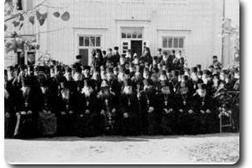
Life in a monastery

Life in a monastery

The main task of a monk is to practice a life of prayer. The most visible part of this is the daily communal services. All members of the brotherhood participate in the services according to their shifts, either as confreres, altar servers, readers, singers, deacons or priests.

Work also forms an important part of the journey. The abbot assigns each brother certain tasks, which are called obedience tasks. All tasks are of equal value in the monastery and their obedient performance is equated with prayer. One may even be absent from a service due to an obedience task.

The brotherhood has a six-day work week. However, services are held every day of the week. From Monday to Saturday, the days begin with a midnight service and a morning service at 6:00 a.m. On Sundays, you can rest longer, as the Third Hour and the liturgy do not begin until 9:00. Obedience work begins after breakfast and continues after a communal lunch at 11:00 until well into the afternoon. From 4:00 p.m., the brotherhood has the opportunity to enjoy dinner before the evening service that begins at 6:00 p.m. The last service of the day ends by 7:30 p.m. on weekdays, and about an hour later on Saturdays. After that, the competitor has his own time, which can be used for reading, going outdoors or resting, for example. Silence on the monastery hill begins at 10:00 p.m. at the latest. The members of the brotherhood go to bed at night according to their own rhythm.

Major church celebrations can cause major exceptions to the weekly and daily rhythms. Short trips – for example, pilgrimages and annual visits to relatives and friends – are also possible with the blessing or permission of the abbot.

The path to becoming a monk

The brotherhood of the Valamo Monastery is open to adult male members of the Orthodox Church who have no worldly ties – for example, dependent children. Physical and especially mental health should also be in good condition, as each applicant for the brotherhood is expected to make a significant effort and be able to adapt to the demands of a close, regulated and regular community life.

There are many reasons for applying to the monastery and they are personal. However, the most important prerequisite for choosing monastic life is a sincere monastic vocation – a desire to live a Christian life of struggle in community, following the will of God.

Those interested in monastic life can contact the monastery's leader, Archimandrite Mikael, in writing. However, it is important for all those planning to enter a monastery to remember that, alongside monastic training, the Orthodox also have another equally demanding and respected way of living in accordance with Christian ideals to choose from: marriage.

The long road to ordination

A person planning to enter a monastery first becomes familiar with monastic life by diligently performing various obedience tasks as an obedience brother, or novice. When the obedience brother has adapted well to the monastery's lifestyle, he receives a blessing from the monastery leader to begin wearing the undercloak, belt, and headdress called a skufia, which are part of the monk's attire. A year or two after entering the monastery, the obedience brother can officially apply for membership in the brotherhood. The entire brotherhood votes among itself on membership. After becoming a full member of the brotherhood, the obedient brother has the right to vote in the brotherhood meetings.

When it is determined that the obedient brother has a firm conviction to commit himself to monastic life for the rest of his life, and when he has been accepted as an official voting member of the brotherhood, he can be ordained as a robe-wearing monk, in which case he is clothed in an outer robe and a veiled headdress, a klobuk. The ordination to monkhood then takes place at a time deemed convenient by the abbot. When taking the final monastic vows, the monk promises to live the rest of his life in celibacy, obedience and without personal property. In connection with the ordination, the monk receives a new name, a rosary and a flowing robe, or mantius, used in church services.

Degrees of monasticism

Obedience Brother
An obedience brother is a man practicing the monastic life in a monastery who has not yet made a permanent vow to live in a monastery. An obedience brother is also called a novice. The abbot blesses the obedience brother with the right to wear the undercloak after about a year of monastic training.

Vest-bearer monk
A vest-bearer monk is a resident of a monastery who has been ordained to the first degree of monasticism. When being ordained as a vest-bearer monk, the actual monastic vows are not yet pronounced aloud, but by becoming ordained, one commits to living according to them. In addition to the undercloak, belt, and skufia belonging to a brother in obedience, a monk may also wear an outer cloak and a veiled headdress called a klobuk.

Monk
A monk is a candidate who has taken the vows of humility, poverty, and chastity that are part of ordination as a monk. As a sign of ordination, the monk is given a new name and is clothed in a long, flowing robe used in church, called a mantilla. A monk ordained as a priest is called a priest monk, and a monk ordained as a deacon is called a monk deacon.

Scheme monk
In the Slavic tradition, a schema monk is usually an elderly and spiritually advanced monk who has been ordained to devote himself to a severe asceticism, or the so-called great schema. A schema monk is exempt from all community obligations, such as communal services, work, and meals, and is allowed to draw up a suitable daily schedule for himself, dedicated solely to prayer. The schema monk's attire includes a hooded garment worn over a cloak, which depicts, among other things, the instruments used to torture Christ and the texts of the psalms.

Archimandrite is a title that can be granted to the head of a monastery, i.e. an abbot, or a distinguished priest monk. The rank of archimandrite corresponds to the rank of a parish priest, although in church services, according to the general Orthodox liturgical order, archimandrites are ahead of the rovast.

In addition to archimandrites, the monastery clergy also includes readers, hypodeacons, monk-deacons, archdeacons and priest-monks. In the Orthodox Church, those who ordain to the episcopate are also monks.

In addition to the brotherhood in the monastery, the visiting parish clergy, which includes readers, deacons and priests, also wear the robe. The monastery clergy and the parish clergy are distinguished in the church by the fact that the parish priest does not wear a veiled klobuk. In addition, monastery residents usually wear a leather belt with their underrobe. Therefore, not everyone who wears a black robe is a monastery resident.

Brotherhood today

For a long time, the average number of members in the Valamo brotherhood was around ten, but in recent years the number of members has increased and is approaching twenty. The average age of the brotherhood is around 45 years.

The members of the brotherhood live in houses built in 1979 on the shores of Lake Juojärvi, which have a total of 16 modestly furnished single rooms, or kelja. The public does not have access to the brotherhood's residential buildings. In recent years, as the brotherhood has grown, some of the brotherhood have also lived in the so-called old monk's hut, which is mainly used by the monastery's volunteers.

In addition to the life of the monk, the monastic life is also traditionally called the life of angels. Its ultimate purpose is the salvation of the soul of the monk. In practice, the life of the monk is an alternation of work, prayer and rest.

Brotherhood members

Archimandrite Michael, monastery director

Archimandrite Herman

Monk Johannes

Monk Aleksanteri, baker of church bread, church equipment manager

Monk Viktor, IT manager

Monk Rafael, monastery secretary, responsible for publishing, agricultural work

Archdeacon Jaakob, responsible for the order of worship

Monk Deacon Siluan, archivist, assistant to the church equipment manager, beekeeper

Scheemamonk Antoni

Monk Alexander, churchwarden

Monk Nasari, vineyard keeper

Monk Joona, guide, brotherhood foreman

Venerable Monk Lavrenti, candle factory manager

Venerable Monk Stefanos, volunteer manager and chief guide

Obedience Brother Tobias, car and machine driver

Obedience Brother Mattias,

Obedience Brother Dimitri