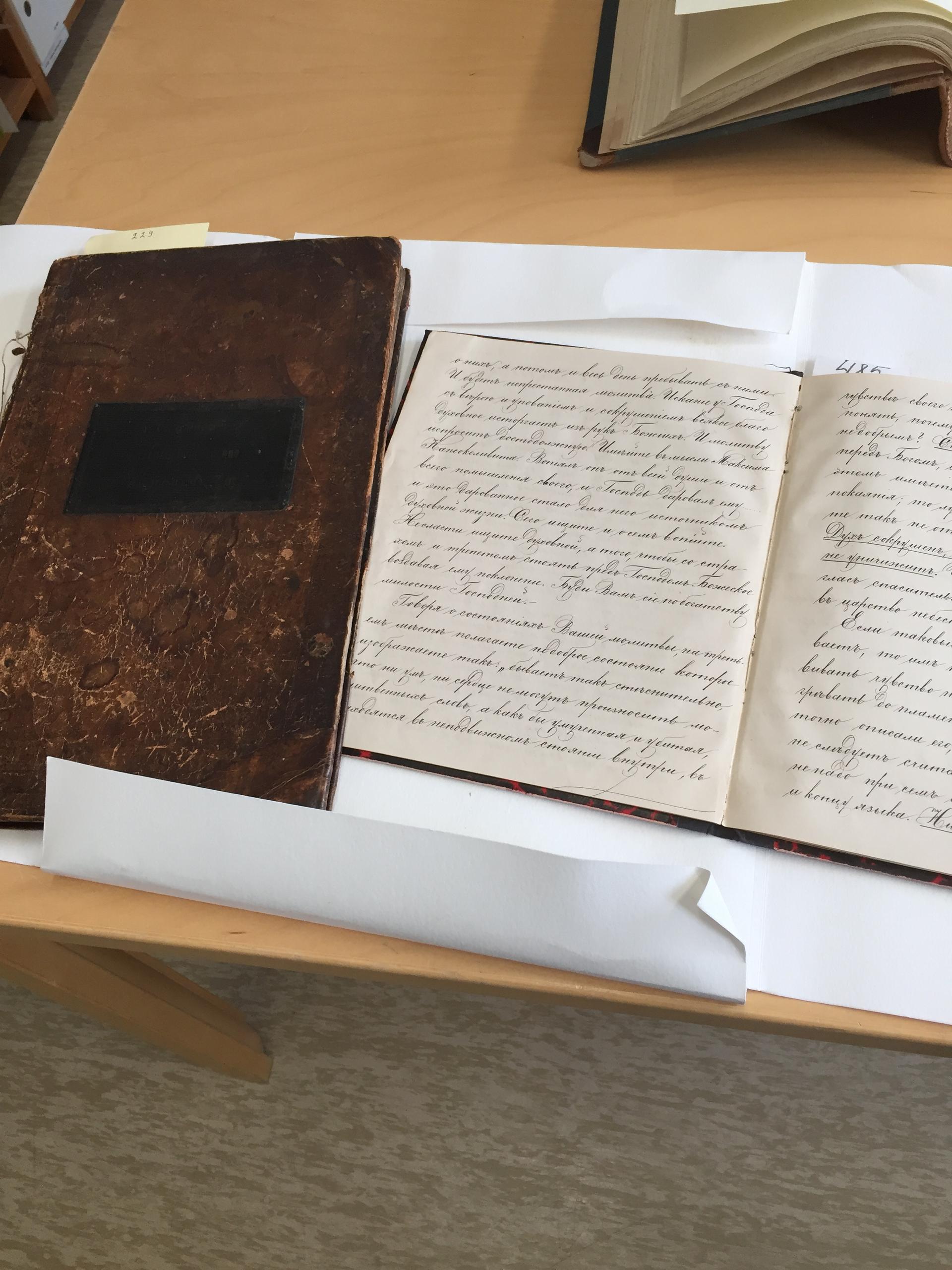
The rich liturgical life of the Orthodox Church requires extensive liturgical literature. The liturgical texts were translated from Greek into Church Slavonic in the 9th–12th centuries. The texts were usually translated and copied in monasteries, and it is likely that manuscript books were also produced for their own use at Valamo early on. Several 15th-century manuscripts bearing the monastery's ownership inscriptions have survived in Russian libraries and archives.
The Valamo book collection thus developed on the basis of manuscripts related to the liturgical life and monastic discipline. The wooden monastery was completely destroyed in the 17th century by attacks by Swedish troops, and the brotherhood was forced to move to the monasteries of Inner Russia. The manuscripts traveled with other valuables, but some were lost along the way. The notes made in the margins of the books tell today's researchers about the journeys and stages of the manuscripts.
From collection to library
In the 18th century, during the reign of Emperor Peter the Great, the reconstruction of the monastery began. The work had to start from scratch, both materially and spiritually. The head of the Sarov hermitage, Nasari, known for his struggle, was appointed as the head of the Valamo monastery (Saint Nasari of Valamolainen). During the long construction period, the monastery received numerous book donations from Russian rulers, mainly teachings of the church fathers, biographies of saints and liturgical books. One of the most notable donors of that time was Empress Elizabeth Petrovna.
The Valamo library as an actual memory organization was born in the 19th century, when the hegumen Damaskin took over the book storage. He organized the books and catalogued them starting in 1830. He kept records of both acquisitions and loans, and also ensured that borrowers handled the books properly. From 1864, the works were arranged according to the classification instructions issued by the Holy Synod. Igumen Damaskin was interested in literature and wrote spiritual poems himself. As a former obedient servant, he had copied books and manuscripts in a hermitage near the Great Scythia. The slow, competitive form of handwriting survived in Valamo long after it had been abandoned in most Russian monasteries.
Igumen Damaskin enriched the library's collection with considerable purchases. The purchases included valuable works, such as Migne's multi-volume Greek Patrology, which contains early Christian literature. He also tried to get literature that had been scattered during the evacuations back to the monastery, but was not always successful. Igumeni Damaskin designed new, stone-vaulted, fire-resistant premises for the library, which were completed after his death in 1884.
The second library builder in the 19th century was Igumeni Damaskin's successor, Igumeni Jonafan II. He added 1,500 volumes to the library's ascetic collection.
In addition, the library's subject matter diversified in the 19th century. In addition to liturgical and spiritual literature, non-fiction books in various fields began to be acquired: works on history, archaeology, hydrology, meteorology, geography, botany, and agriculture. This literature served the development of the multifunctional monastery and the expanding economic structure. Foreign language literature and fiction were also included in the scope of acquisitions.
Publishing activities of the Valaam Monastery
The publishing activities of the Valaam Monastery began in 1863. At that time, on the initiative of Igumen Damaskin, P. I. Balashov's large-scale color lithograph album Sobranïe vidov městnostej ostrova Valaam was published. The work depicted views of the Valaam monastery islands and the visit of Emperor Alexander II and Empress Maria Alexandrovna to the monastery.
Publishing activities have continued from the 1860s to the present day. Initially, Russian-language works related to the history and competitive life of the monastery were published. The history of the monastery was now widely depicted in printed form for the first time. Based on the material contained in the works, new booklets intended for pilgrims were written. The authors were often church historians and hagiographers of the time. Some of the works are written by the brotherhood, such as Archimandrite Pimen's portraits of the monastery's competitors. In addition, several photo albums were published at different times using the photos from the monastery's photography studio.
Finnish-language publishing activities began in the 1920s, when the monastery's board published the first Finnish-language general presentation of the Valamo Monastery. In the 1930s, Finnish-language spiritual and ascetic literature began to be published regularly.
After the evacuation, Valamo's publishing activities only experienced a new upswing in the 1980s. By the 2010s, over 200 works had been published in the Valamo Monastery book series. The Valamo Book Club also operates in connection with the monastery, which provides its members with works published by the monastery and other Orthodox literature.
The monastery library's collections contain all the publications of the Valamo Monastery as archive copies. Newer publications can be borrowed from the new collection.
Heinävesi Valamo, the new beginning of the Valamo monastery library
Most of the Valamo library collection was brought to central Finland when the monastery was evacuated in February 1940. In Papinniemi, the books were stored in the attic of a cart shed, where the books were kept for almost twenty years. Some of the books were placed in the reference library used by the brotherhood. In 1959, approximately 14,000 volumes were handed over for safekeeping to the Helsinki University Library (now the National Library) storage library in Urajärvi. The Slavic Department of the Helsinki University Library catalogued the collection. Copies of this catalogue in card format are in the Heinävesi Valamo library.
The library's evacuation period ended in 1984, when the library space in the cultural center was completed. The builder of the Valamo Monastery Library in Heinävesi was the currently retired Metropolitan Ambrosius. His acquisitions have given rise to a new collection of the library, which continues the ascetic tradition of the Valamo Library in Ladoga in the modern era. The Valamo book and manuscript collection in Ladoga was moved from Urajärvi to the vault of the new library building in the 1990s and was organized according to the classification of the Holy Synod.
A new multilingual and multicultural collection is located under the Byzantine octagon. It contains both the core areas of Christian literature of silence and the call to a simple, creation-respecting lifestyle that is relevant in our own time.
Original text: Pia Koskinen-Launonen. Text updated by Virva Suvitie.